
Jenkins County Court Records After Arrest
Court records after a jail arrest in Jenkins County answer a different question than jail records. The jail can confirm current custody, booking charges, bond status, and release information. The court record shows what the prosecutor filed, which court has the case, and what happened after the arrest moved into a formal case. Jenkins County is in the Ogeechee Judicial Circuit, which serves Bulloch, Effingham, Jenkins, and Screven counties. The First Judicial District page lists District Attorney Robert Busbee for the circuit.
The GSCCCA Jenkins County clerk listing names Tracey Herrington as Clerk of Superior Court and lists Superior, State, and Juvenile courts. The listing gives clerk hours as 8:30 a.m. to 5:00 p.m., Monday through Friday, with phone (478) 982-4683. Use Jenkins County inmate records for the custody side and Jenkins County jail mugshots for booking-photo questions.
Find Jenkins County Court Records After Arrest
The Georgia Courts e-access page lists Jenkins State and Jenkins Superior in the court-record access directory. The page says users are redirected to the provider's website and must have an account to search court records. That makes e-access a starting point for court records after an arrest, but official copies, older records, and records not visible in the provider system should be checked through the clerk.
- Search Georgia Courts e-access for Jenkins State or Jenkins Superior, depending on the case type.
- Use the defendant name, case number, or provider fields available after account access.
- Open the case record and read the filed charge list, status, hearing dates, and bond entries.
- Contact the Clerk of Superior Court for official copies or records that do not appear online.
- Use the jail phone line only for live custody and booking status, not final court disposition.
The captured Georgia Courts e-access directory is the source showing Jenkins State and Superior as court-record access entries.
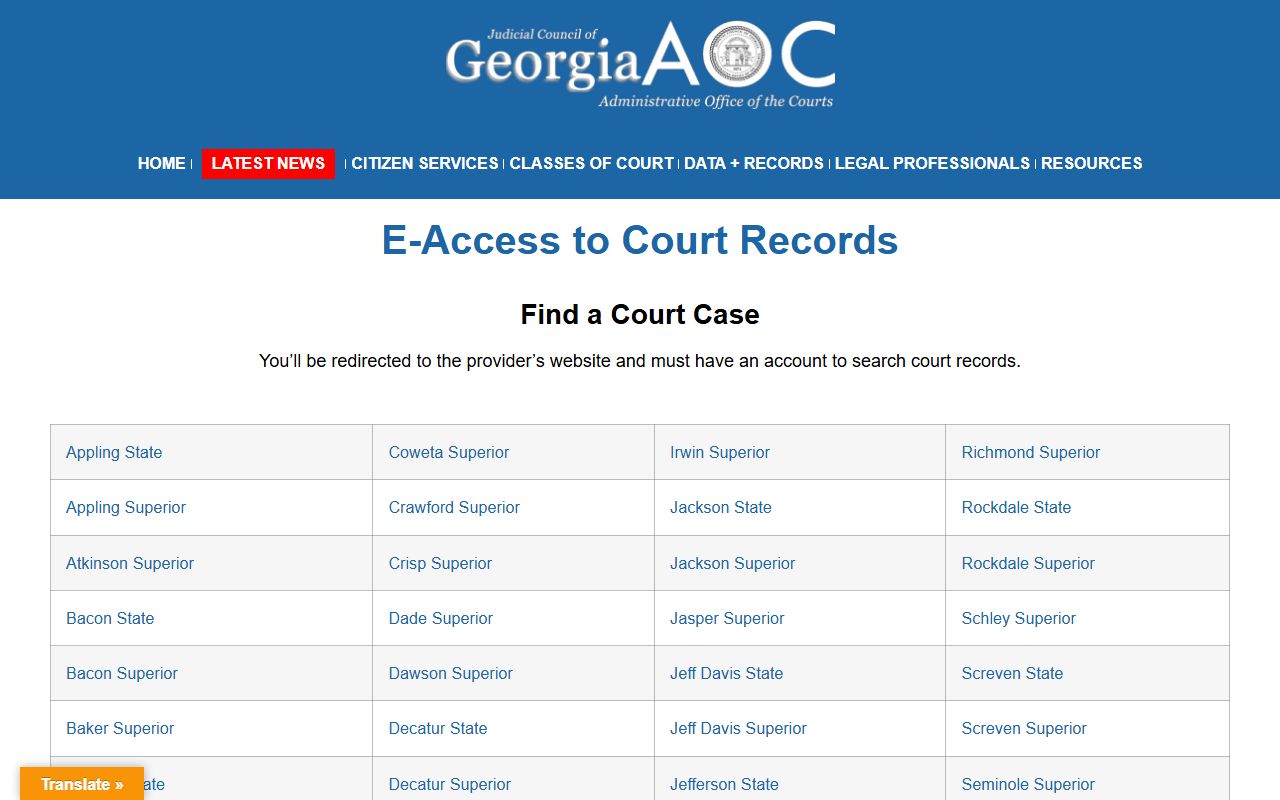
The screenshot supports the search path because it shows the statewide access directory used before contacting the Jenkins County clerk.
Jenkins Court Record Search Fields
The research found only limited public field information because Georgia Courts e-access redirects users to a provider and may require an account. The known search path still helps. Select Jenkins State or Jenkins Superior when available, sign in or register if required by the provider, then search using party or case details supported by that provider.
| Field | Type | Required | Notes |
|---|---|---|---|
| Court or provider selection | Link list | Yes | Jenkins State and Jenkins Superior are listed separately. |
| Account or login | Registration/login | Yes per Georgia Courts page | The directory says users must have an account. |
| Party or case fields | Provider search | Unspecified | Exact labels were not captured because access redirects. |
Booking Charge to Court Charge
The arrest-to-court path begins with booking at Jenkins County Jail. That booking record may list an arrest charge based on warrants, citations, or officer paperwork. The prosecutor then reviews reports and may file fewer charges, more charges, amended charges, or different charges. The Ogeechee Judicial Circuit District Attorney is the key office for many felony and state prosecutions tied to Jenkins County.
Once filed, the case record belongs to the court and clerk system, not the jail. It may show a formal charge, case number, filing date, judge, next event, bond order, plea, sentence, dismissal, amended count, or disposition. A jail phone call may still be useful for custody, but court records after a jail arrest are the better source for the current legal status of the charge.
Custody flow: Arrest to booking to first appearance or bond to prosecutor review to court filing to disposition or sentence.
Charges After a Jenkins Arrest
Georgia criminal cases can move through different charging documents depending on the offense, court, and prosecutor action. The research points to accusations and indictments as documents the prosecutor may draft, and it notes that booking charges can differ from filed charges. The plain-English point is simple: the jail charge is an intake label, while the court charge is the case record that judges, prosecutors, clerks, and defense counsel work from.
| Document | Who Is Involved | What It Does |
|---|---|---|
| Complaint or warrant | Law enforcement and judicial officer | Supports arrest or early case handling. |
| Accusation or information | Prosecutor | Files formal charges without a grand-jury indictment where allowed. |
| Indictment | Grand jury and prosecutor | Charges serious felony counts after grand-jury action. |
Jenkins Charge Status Records
Charge status terms are easy to misread. Pending means the case is still open. Dismissed means the charge ended without conviction. Nolle prosequi means the prosecutor declined to continue that charge. Amended or reduced means the filed count changed. These terms should be read from the court record, then checked with the clerk when an official copy is needed.
| Status | Meaning |
|---|---|
| Pending | The court case or charge is still open. |
| Amended or reduced | The filed charge changed after review or negotiation. |
| Dismissed | The charge ended without a conviction on that count. |
| Nolle prosequi | The prosecutor chose not to continue that charge. |
| Disposed | The court entered a final outcome, such as plea, verdict, dismissal, or sentence. |
Bond Records After Arrest
Jenkins County does not publish a jail bond page in the research. Call 478-982-4211 first to ask whether bond has been set, what type of bond is accepted, where it must be posted, and whether any hold prevents release. Once a case exists, court records may show bond orders, amended bond, next hearing dates, and conditions. Do not assume the jail accepts every payment type or that a bondsman can release someone with a no-bond hold.
| Bond Type | How It Works |
|---|---|
| Cash bond | Full amount is paid to secure release, subject to local payment rules. |
| Surety bond | A licensed bonding company posts bond if surety is allowed. |
| Property bond | Eligible property may secure bond when the court allows it. |
| Own recognizance | Release is based on promise and conditions rather than full cash payment. |
| No-bond hold | Release is blocked until a judge or holding agency changes status. |
Warrants Before a Jail Arrest
No official Jenkins County active-warrant search page was located. The sheriff's patrol page says deputies serve papers and provide court security, so the sheriff remains the practical local law-enforcement contact. For warrant questions, call the sheriff or jail at 478-982-4211, contact the clerk for court-filed warrant or case records, or use Georgia Courts e-access when a filed case exists. Do not treat e-access as a guaranteed active-warrant database.
- Arrest warrant
- Authorizes arrest based on probable cause.
- Bench warrant
- Issued by a judge, often for failure to appear or a court-order violation.
- Search warrant
- Authorizes a search of a place or item and is not an inmate custody record.
- Hold or fugitive warrant
- May show another agency wants the person held or transferred.
Charges vs Convictions
An arrest and a charge are not convictions. A booking charge records why a person entered jail. A filed charge is an accusation in court. A conviction requires a plea, verdict, or other final court outcome. Jenkins County court records after an arrest should be read with that sequence in mind, especially when a charge has been amended, dismissed, or restricted later.
| Charge | Conviction | |
|---|---|---|
| Stage | Accusation or filed count | Final outcome by plea or verdict |
| Meaning | Not proof of guilt | Legal finding or admitted guilt |
| Where it appears | Booking and court records | Court disposition and criminal history |
Restricted Court Records After Arrest
Georgia uses the term record restriction rather than expungement in many contexts. The GBI record-restriction page cites O.C.G.A. 35-3-37 and explains that eligible criminal-history records may be restricted for non-criminal-justice purposes when approved by the prosecutor. Restriction does not rewrite every court file, jail record, or third-party copy, so confirm the correct process with the clerk, prosecutor, or counsel.
| Restricted or Sealed | Expunged or Removed | |
|---|---|---|
| Public view | Limited for eligible users or purposes | Removed or treated differently where law allows |
| Georgia term | Record restriction is the key GBI term | Expungement is often used casually |
| Who to ask | GBI, prosecutor, clerk, or attorney | Agency that controls the record |
Public Record Search
Sponsored Results